Showing posts with label mystery. Show all posts

Saturday, October 23, 2010

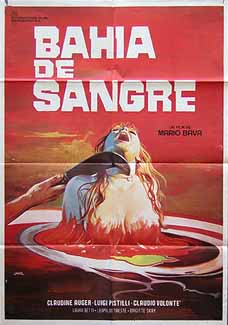
BAY OF BLOOD (1971) Movie Review

BAY OF BLOOD (1971)

bay of blood movie poster


On a grand estate on the shore of a bay, an elderly woman clings desperately to the land so that it will not be bought and turned into a resort. However, her murder sets off a chain reaction that brings all of the potential heirs to the estate out of the woodwork, and more disturbing, an unknown killer who begins to systematically murder each of these heirs. The situation takes another turn for the worse when a group of teenagers decide to trespass on the estate, and are quickly targeted by a killer who knows no remorse, sympathy, or limits to their cruel imagination for slaughtering their next victim.

In 1970s Italy the murder-mystery, also known as a giallo, was coming into its golden age soaking the screen in blood, filling it with red herrings and sleazy sexuality and generally confusing the hell out of the audiences with complicated plots. But when famed director and writer Mario Bava brought BAY OF BLOOD to the screen, it was like nothing anyone had seen before. Starting off from a generic storyline that could be found in any run-of-the-mill giallo, Bava quickly amps everything up from the almost insane weaving of all the characters' relationships, to the one-after-another murders that are each committed in a more horrific way, to the gratuitous and graphic sex and nudity.

This film has become known as the very first official slasher film, and is (or at least should be) the water mark to compare all other films that compete for the slasher subgenre label. In America, it can be debated whether BLACK CHRISTMAS or HALLOWEEN was really the first US slasher film, though both owe all their screen credit to Bava's masterpiece. The early FRIDAY THE 13TH films in particular also borrow heavily from this film, right down to the first-person POV and some of the signature murders in the series. For better or worse (and for most fans it is probably the better), due to BAY OF BLOOD, sex and violence will always be married in the slasher genre.

It is not just that the film is the very first slasher, it is a great slasher and can still to this day hold up against any would be film adversary. The groundbreaking murder sequences within the film alone make the film worth seeking out, even if you are passive fan of the genre. The make-up special effects, helmed by Carlo Rambaldi (who would later work on E.T. and ALIEN among others) can still hold up almost forty years later, which is testament to their realism. It is truly a crime that as the years passed this film has become more obscure, fallen off the "must see" lists of some horror stalwarts, and may even be unknown to younger and newer faces to the horror scene.

This was one of the last films that Mario Bava would make, and it is a culmination of a lifetime of work. Even though the movie's essence can be boiled down to a horror shocker, each of the film's individual parts are given the respect and professionalism that would be seen in a high art or dramatic picture. Bava has always been known as one who uses color to manipulate and enhance his films, and it is no exception here. The music plays a critical part in setting moods and building up suspense. Bava's camerawork pulls from the well established "unknown killer" motifs and makes them his own, which set the stage for future directors and cinematographers to mutate to their own needs.

Any horror fan owes it to themselves to give this film, and Mario Bava, the full credit and respect that it deserves, and that even if it doesn't become a permanent part of your home collection, that it is seen at least once for historical purposes. When watching this, try to keep in mind when it was made practically no one had done anything like this before. And guaranteed, no one will see the ending coming, nor has anyone had the balls since to make an ending quite like BAY OF BLOOD. The couple being double-impaled on the bed while having sex is just icing on the bloody cake.

Tuesday, July 13, 2010

DEEP RED Movie Review

DEEP RED (1975)


Helga is a telepathic visiting Italy who feels the frightening presence of a disturbed mind when she is at a lecture. That night, while trying to focus on that mind, she is brutally killed by a hatchet-wielding maniac. Her death is seen by Marc, a jazz pianist who lives in the same building as her. While trying to save her, Marc thinks he sees something as he races through her apartment. It is this sliver of memory, that he can't recall if he imagined or if he truly saw something, that propels him through the city streets, trying to piece together the puzzle. His path leads him into constant contact with a local reporter, Gianna, who is trying to make a name for herself. But as each piece comes into play, or as a person comes too close to a vital clue, the black-gloved assailant returns from the shadows to murder again. Marc is certain that he is closing in on the truth, but the final discovery could also spell the end of his life!

Director and co-writer Dario Argento once again returns to a familiar world of unknown killers in this genre defining mystery, which was also written by Italian screenplay master Bernardino Zapponi. Together, the two create a film that would shape the crucial ingredients for the 70's giallo - shocking gore, a dizzying storyline, characters that evolve so that any of them could be the killer, and a pounding soundtrack. But though these would be the standard ingredients, it is Argento's eye aided by Luigi Kuveiller's cinematography that keeps DEEP RED a unique film experience that brings fans new and old to the movie again and again.

The story, which revolves around Marc Dely (David Hemmings), is a swirling mystery that keeps the viewers guessing throughout, offering red herrings and subplots to keep things interesting throughout the two hour plus running time. Like most of the gialli that precede DEEP RED and like the hallucinating Argento films to follow, the story often plays second fiddle to the atmosphere and style of the set designs where the scenes take place, but it is never compromised to allow such scenes to exist. The script also allows room for some sex equality banter between Marc and Gianna (Daria Nicolodi), as they vie against one another to be the more important amateur detective.


Argento literally goes for the throat in his quest to shock the audience with his brutal assault on the body. The film's title indeed delivers, as the deep red stuff pours several times throughout, and each one out does the other. Helga's murder, which we all know is coming but is still startling when it does happen, sets the bar high early on. Her attacker cleaves her several times with a hatchet, and each time we see the blade sink in. It is a horrific murder, and Macha Meril's screams resonate in the air. Argento keeps the shocks coming, as a woman's head is scalded, a knife pins a victim's head to a table through the neck, another head is crushed, and the finale death that must seen to be believed. In the ironically titled alternate version THE HATCHET MURDERS, almost all of the gore is cut out, so it is best to avoid that one.

Beyond the atmospheric sets and the always-thinking storyline, is Kuveiller's stunning work with a camera. Early on in the film, the camera pans across a series of small objects, leading up to an extended switchblade. Each item is larger than life, crisp and in focus, and the fluid of the camera as it pans so close is just breathtaking. The camera repeats these extreme close ups of objects throughout, each time with the same precision, bringing our eye so close that we are unable to see the importance to object represents. Argento's framing of scenes, accompanied by the elaborate crane shots, wild zooms, and dollying through windows continues to be as smooth and fluid as a quiet stream. The camera merely hovers and floats around the characters trying to keep up with the subtle important clues.


Also hovering around the characters is the incredible thumping and booming of prog-rockers Goblin. DEEP RED marks the first of several collaborations between Goblin and Argento, and their work here turns the concept of music to create mood head over heels. Often times, when one would normally expect a soft violin or small horn section drawing out single notes to build suspense, Goblin cranks up the deep driving bass, lets the guitars rip, the keyboard eerily chime, and the tom-toms rattle and roll. The result is almost a music video, with a band playing over the scene, instead of being part of it, and slams out much louder than any of the conversations and ambient background. Goblin would go on to much wider acclaim with their soundtrack work on the Italian cut of DAWN OF THE DEAD, but here is where they got their start and created an unequivocal sound in the world of horror.

Over thirty years later and even looming in the shadow of Argento's greatest triumph, SUSPIRIA, DEEP RED remains an important part of both his filmography and the horror community at large. The professionalism of all involved, as well as the daring use of music, keeps this movie at the head of the list of Italian giallos. In a distant past where gore was an asset and accompaniment to the story instead of merely a distraction, Dario Argento was one of the greats.

Wednesday, June 4, 2008

SCHIZO Movie & DVD Review

SCHIZO (1976)


When professional ice skater Samantha’s wedding plans are splashed across the newspaper, a grizzled-looking man sees the announcement and makes a trek to from northern England down into London. Once there, he begins to torment Samantha, starting with the placement of a bloody knife at her wedding reception. He continues his psychological games with phone calls and even places an old photo of Samantha’s mother in her house where she will see it. Samantha tries to explain to her new husband that she is being followed, but hesitates to give him any real details.

Worried for her safety, Samantha finally turns to her friend Leonard for advise. She admits to him that she knows the man, who went to jail for murdering her mother and now Samantha thinks he is after her. Leonard is skeptical, and brushes it off as purely an over-active imagination. But when people close to Samantha start showing up murdered in a most gruesome fashion, she knows that it is only a matter of time before she will again have to come face-to-face with her past, and that this time she may not survive.

Read my full review at The DVD Lounge!

Tuesday, July 31, 2007

THE RED QUEEN KILLS SEVEN TIMES Review

RED QUEEN KILLS SEVEN TIMES (1972) As little girls, sisters Kitty and Evelyn learned from their grandfather about their family legend - that every 100 years one sister would murder six innocent people before finally killing the other sister. Now an adult, Kitty has become a popular photographer, while it is believed that Evelyn has disappeared to America and her third sister Franziska cares for grandfather. It is now the anniversary of the legend, and in the dead of a January night, a woman dressed as the Red Queen materializes from the shadows, and murders the grandfather. Everyone immediately suspects that it is Evelyn, but Kitty knows that is impossible, for Evelyn has been dead for months, accidentally killed by Kitty's hands.

When Kitty's boss becomes the next victim of the red-cloaked killer the suspects list opens up, including Martin, Kitty's lover and next in line to become head of the fashion corporation. More importantly, the covered-up death of Evelyn may be threatened, as both Evelyn's boyfriend has been desperately searching for her, and eyewitnesses to the murders have described the killer have features that resemble Evelyn. As the bodies start piling up, Kitty becomes frantic to figure out who is using her family's past to eliminate those around her before she finds herself on impaled on the vengeful killer's knife.

From director Emilio Miraglia, who is best known for his other mystery film, The Night Evelyn Came Out Of The Grave (1971), this lesser-known, but wonderfully suspenseful Italian mystery-thriller (these are also referred to as giallo films) features all the necessary trademarks of the genre - brutally violent deaths, copious amounts of nudity, a swaying musical score and more red herrings than a fish market. The murder sequences in Red Queen are some of the more graphic examples in genre, including one that involves a wrought-iron spiked fence, and pushes the boundary of acceptable violence in 1970s Italy. Red Queen also adds some gothic imagery into its overall feel, which helps the film standout in comparison to its contemporary brethren.

Red Queen gives needed clues throughout the film, as well as offers several fake suspects to throw off the mystery film watching sleuth that will try to figure it out before the end. But as with many well-written giallo films, the story line here will have you guessing until the inevitable final scenes where the mastermind explains the entire scheme. Unfortunately, when everything is explained at the end, it brings in too many elements and is spoken far too quickly to fully comprehend. This is the movies greatest flaw, so viewing this on DVD will allow for the added benefit of rewinding and listening again to the explanation.

On a whole, this is a really good place to start for the introduction into the giallo genre, which has been receiving a well-deserved renaissance over the past few years on DVD here in America. Other easily accessible films to keep an eye out for include The Case of The Scorpions Tail, Your Vice Is A Locked Room And Only I Have The Key and What Have You Done To Solange?

Saturday, July 28, 2007

RENAISSANCE Review

RENAISSANCE (2006)


It is the year 2054. Mega-corporation Avalon, whose primary products promise "youth and beauty", has permeated themselves into most aspects of modern life. When one of their star researchers, Ilona, is kidnapped, Karas is put on the case to find her. His rough and gruff means of data extraction and detective skills are both a contrast to the beauty that the city of Paris wants to show, and a mirror reflection the city's underbelly. As Karas interviews those that are associated with Ilona, and the hidden truths that her very worried older sister Bislane finally reveal to Karas, he comes to the suspicion that Avalon may in fact be behind Ilona's kidnapping, or even one of her closest friends. He also becomes acutely aware of just what Ilona was researching, and what it could mean for civilization's future.

From debut director Christian Volckman, who spent seven years bringing his creation to the screen using rotoscoping animation (the process in which live actors and actions is animated; think the recent A SCANNER DARKLY or A-Ha's classic "Take On Me" music video), comes this highly-stylized black and white sci-fi noir. Taking many of its visual cues and technology inspirations from the reigning champion of sci-fi nor, BLADE RUNNER, as well as inspiration from Frank Miller's high-contrast artwork in his Sin City graphic novels, Volckman has set out to create an animated feature film for adults with a love of near future envisioning and speculation.


Volckman and his animation designers have set out to imagine what will happen to the visual appearance of Paris over the next fifty years. The result is a lovingly rendered vision of a sleek, clean, and beautiful cityscape, with walkways and entire rooms made completely of glass, giving the city and open and welcoming atmosphere, while still retaining a sense of history, as the Eiffel Tower is still a center piece of the city . Technology gets a huge bump in this vision of the future as well, as computers, cars, police equipment, and medical instruments get a very realistic advancement from today. We can see the technology that they are using as a distant descendant of what is in use in our modern world. Surveillance and video recording also gets a massive future imagining here. Taking cues from the already Big Brother-esque camera installations all over many major around the world, in Volckman's future Paris, cameras and microphones are everywhere, with huge control rooms overseeing all of the information being taken in.

This is one of the truest examples of a "black and white" film, in that there is absolutely no grey scale in use to bring the vision of the future to life. White rain falls against a black sky, characters disappear within the inky abyss of shadows, pure white light cuts through otherwise pitch black dance clubs in throbbing blasts. Extraordinary attention is given to the human characters, and though the expressions were originally made by a real person, you forget on multiple occasions that you are watching an animated version of those emotions. The artistic talent that is backing up Volckman's world here is breathtaking, and at many times the movie almost does appear to still retain its live action origins. Backing up the visualization is an equally impressive audio accompaniment.


The soundtrack assists most of the scenes quite well, enhancing the mood and atmosphere. The blips of the technology, as well as the ambient background hum of the city, provide a layered dull hive buzzing of a very real and living city. Also along for the ride in the English language dub of the film are several prominent names. Daniel Craig provides the lead voice of Karas. Jonathan Pryce and Ian Holm are also on hand in smaller supporting roles. And unlike some celebrity-voiced films that have been seeping into the theatres recently, these actors take a cue from real voice actors, and create characters with their voices. Their names are there for a bit of publicity, but if you didn't know it was them, you wouldn't be able to guess who was speaking.

The story narrative itself takes a backseat to the visual flair rocketing across the screen, and at many times Karas' investigations seems to exist solely to bring the viewer into the multi-layered social spectrum of this future Paris. There has been a lot of time and effort put into creating a very realistic and operating city, and Volckman intends to show it off. His "camera" swoops and sways through the city as it follows Karas, pulling off otherwise impossible angles, zooms, and crane shots, and bleeding through solid objects in continuous motion. An exhilarating car chase, which zips through most of the city over the course of a few minutes, is a highlight of the movie. The story is nothing groundbreaking, with many aspects of the classic detective motif merely updated and adapted to reflect the future world, but it is at least engaging, and seems quite plausible given the future setting, and has just enough mystery and subtle clues that will have any armchair sleuth trying to keep up or figure out the riddle.


Once again, an animator has taken a bold step is bringing down the concrete wall that separates animation as a genre (read "kids entertainment") and as a medium to tell a story. And here it is used perfectly as a medium to tell the story and bring a future Paris to life. Japan has long known the full range and potential that animation holds as a medium to bring compelling and entertaining cinema to the screen. And with recent works such as RENNAISSANCE and the ever advancing CGI getting closer and closer to photo realistic rendering, that wall is slowly chipping away both here in America and Europe. There will be a day, sooner than later, where these films will be seen not in festivals, art houses, and home theatres but in a multiplex. And that will be a day worth going to the movies.

Tuesday, July 17, 2007

MEMORIES OF MURDER Review

MEMORIES OF MURDER (2003)


It is 1986, in South Korea. In a small village, a young woman is found raped and brutally murdered. The local police force is completely caught off guard, and have no idea how to handle the situation. Then another body is found, and they realize they are dealing with a serial killer, which they are completely unequipped to deal with. Detective Park (Song Kang-Ho, of SYMPATHY FOR MR VENGEANCE and JOINT SECURITY AREA) and his partner resort do what they do best - hauling in suspects on the slimmest of evidence and "interrogate" them endlessly hoping to get a confession.

When Detective Seo arrives from Seoul, he brings with him a more sophisticated set of police skills, and quickly dismisses the suspects captured based on a little real investigating. However, the damage has already been done, and the village citizens know all about the interrogation tactics being used to try and find the suspect, which makes their job even harder. As months pass, and other women fall victim to the killer, small yet crucial clues focus the police squad's eyes on a local factory employee. But they find in this suspect an adversary that will not submit to a few threats, and proclaims his innocence. Is this the man they've been after, or merely another faux-suspect that merely matches their shaky evidence?

Based on the true serial killings in South Korea that took place between 1986 and 1991, MEMORIES OF MURDER is a gritty, downbeat detective film that rivals SEVEN for its intelligence and character analysis. Director and co-writer Bong Joon-Ho (whose current film THE HOST is tearing up cinemas worldwide) carefully and slowly unfolds this tale that focuses on the pressure and stress of Detectives Park and Seo as they struggle against each other in terms of tactics and struggle to find common ground that will allow them to finally capture the killer. He uses subtle camerawork to capture the progressing story, and slips into a Cops-documentary style to get the more frantic scenes. This particular style culminates in a spectacular and spinning nighttime foot chase through the village.

Bong tackles some hard topics, as he focuses on the slightly-inept police force who simply want to find a suspect and close the case, the all-too-familiar interrogation room tactics used. These are some of the more disturbing scenes of the film, and certainly the most graphic in terms of violence. The film is decidedly anti-police brutality, as important and valuable time is lost as the characters take the easy route in kicking and torturing innocent suspects, which leads to more victims being killed. The actual killings are all done off camera, with only the aftermath shown briefly, which creates the huge grey area that the film lives in. Here, there is no black and white, and even the best intentions by the protagonists are bruised with bloodied knuckles.

Song Kang-Ho and Kim Sang-Kyung (who portrays Detective Seo) fully immerse themselves in their respective roles. While at first Park is the time-bomb cop who does what he needs to get results and Seo stays even-tempered and calculating, as the film progresses the dynamic roles slowly reverse. Park matures his style as he realizes what a real detective is supposed to be, while Seo becomes unhinged dealing with hopeless frustration. The character switch completes itself during the film's climax, as Seo falls from grace with a single pistol-whip while Park redeems himself as he finally puts his full trust in lab paperwork.

At over two hours, the film does take its time to get to each of its destinations. For those that have become fully acclimated to Hong Kong and Korean pacing, there should be little difficulty waiting out the slower scenes. There is little action to be had during the entire picture, and even the "adrenaline" pumped scenes barely get above a steady jog. This is 100% conversation-based cop drama. The only main problem, which is purely subjective, is the film's lack of time pacing and the immense criminal investigation. There are no dates given as the film progresses to present the length of passed time - the movie starts with the first murder in 1986, but no way to tell how many years into the investigation the film goes, nor is there any scope to the epic scale that the case covers. According to the film's trailer, over 3000 suspects where checked and thousands of police officers where involved, however the actual film give the assumption the suspects and police involved are centralized to the village area the murders take place in.

For Eastern Asian crime-and-investigation junkies, this is a no brainer to watch. Past that, it becomes a crap shoot. The film is not very enjoyable, due to the harsh subject matter, and if you enjoy your cops with a healthy dose of pulp-action this should probably be skipped. Suffice it to say, if you liked SEVEN and can take the grimmer episodes of Law & Order: Special Victims Unit, definitely keep this one in mind.

Sunday, June 24, 2007

BRICK (2005) Movie Review

BRICK (2005)


In a southern California high school, loner Brendan is a sharp-witted senior who keeps to himself, though he seems to be known by just about everyone else. His ex-girlfriend, Emily, has been missing for a month, until she makes a brief contact with him via phone. Brendan realizes she is in trouble, and starts compiling information to figure out what has happened. After following up on a clue, he finds her dead body in a drainage tunnel. He immediately sets his sights singled-mindedly on discovering the who's, how's and why's of her murder. He hides the body, so that he may investigate without police interference, and brings his only real friend, The Brain, as surveillance and intelligence gathering.

Using his fists to back up his wit and words, Brendan begins to uncover a large drug distribution circle that is headed by the mysteriously unknown Pin. As more clues pile up and the motives and loyalties of those around him are uncovered, the truth behind Emily's death comes within his grasp, even as a potential drug turf war threatens to explode because of his actions. To embellish the plot and story any further would be to rob the viewer of what is perhaps the finest detective story to grace the small screen since LA CONFIDENTIAL was first released on VHS.

What PUMP UP THE VOLUME did for high school loners wanting to express themselves in the 90's, BRICK will do for high school loners wanting to prove themselves in the new millennium. Joseph Gordon-Levitt, who is no stranger to the role of a high school student (he's been playing one since the late 90's), takes on the role of Brendan, and delivers what may be his best performance yet. He tackles the tricky dialog (more on this in a moment) with the superior gusto and a natural ability that would make you think he talks like this all the time. The movie follows Gordon-Levitt exclusively, and thus he is in almost every scene. Even the most trained actors could break under this strain, and possibly destroy the movie in the process, but he dryly flows from scene to scene with the same confidence of his character, and makes the movie work.

All of the supporting cast work with the same confidence and diligence as Gordon-Levitt, and everyone in this film looks like they could have been pulled from a local high school. This is a rarity in today's slick and polished high school film, and is essential for making the movie work. They each perform a certain archetype (again, more this in a moment), but never all themselves to be cornered as a stereotype, which is paramount for this movie to play as it does.

Rian Johnson, the director and writer of BRICK, returns to the world of sullen teens, a world he first helped to edit in 2002 with MAY, a horror-drama in which a young woman, who's desire for the perfect friend, goes to extreme lengths. Here, Johnson pulls from seedy 1940s noir worlds of Sam Spade and Philip Marlowe, and places them in a contemporary school setting. If you were to watch the film with only the volume, it could easily be misinterpreted as something made during the film noir hey-day. It is written that flawlessly. The characters speak their lines, which about as far from how a teenager would normally speak, as if they really did speak this way. Each character fills the needed void of what is needed in such a scenario. Brendan takes on the role of the private dick who do what he must to get the answers he wants. Emily does the standard dame in trouble that winds up dead. The Brain takes on the bookworm assistant who can decipher the clues. Tug takes on the role of the muscle-head heavy. Laura takes on the dressed-in-red femme fatale. The Pin, who at 26 is the only character not in high school, is the crimelord who thinks he is pulling the strings. Finally, the vice principal personifies the hardly seen but always looming by-the-books law.

With all fingers crossed, hopefully this film will land in the hands of teen movie watchers, and make them realize that a smart and purpose driven film can play out in the halls of a school, and that there is more out there than BRING IT ON, JOHN TUCKER MUST DIE and the rest of their substandard ilk. If this film does find its audience, and with the correct word of mouth it should, this may open the doors for a resurgence in smart detective thrillers. This is a smart film, and needs to be actively watched and listened to. So pour yourself a double scotch, get your a pocket notepad, prepare the ice to stop your bloody lip from swelling and set out to discover the mystery behind BRICK.

Tuesday, June 19, 2007

STRIP NUDE FOR YOUR KILLER (1975) Movie Review


STRIP NUDE FOR YOUR KILLER (1975)


When a fashion model dies during an abortion, it sparks a series of murders that are all connected to the modeling agency she worked for. As the models drop like flies in grisly deaths by a mysterious killer dressed in a leather jumpsuit and motorcycle helmet, those remaining alive become the key suspects by the police who are unable to crack the clues left behind. The key suspect becomes Carlo, a hot-tempered photographer who would rather keep vital information to himself and try to solve the case himself, even if it means putting his lover Magda and his boss in mortal danger of becoming the next nude body to be found.

Director Andrea Bianchi, who would later gain horror notoriety as the director of the zombie shocker THE NIGHTS OF TERROR, sets the mood right away for the sleaze-drenched giallo. His opening credit sequence, a grainy night time drive through Italy's neon lit sex and crime riddled streets (think TAXI DRIVER's opening) with a soft and jazzy score, instantly gets you in the right frame of mind. The film's title doesn't hurt either. He takes full advantage of the giallo cliches and themes that had been established during the past five years or so - utilizing killer POV shots, a swirling and baffling plotline that will remain a mystery until the final reel, and of course copious amounts of gratuitous nudity from practically the entire cast.

Bianchi, who also wrote the story, sets up his murder sequences with a relishing delight using false scares and shocks before getting to the true blood-spraying final blow. The effect is a great success, keeping a high level of suspense for the viewer, who never knows if the next swoosh of the camera lenses will bring the relieving view of an innocent face or a close up of a shiny black helmet as a blade plunges into flesh. Bianchi doesn't shy away from the red stuff here. He know what his core audience wants and delivers in spades. Though the blood is brightly colored (and obviously fake) it doesn't take away from the demise of the victims, and the over abundance of arterial sprays helps to make up for the inaccurate color.

At the other end of the spectrum of murder sequences in a picture like this is the aforementioned gratuitous nude and borderline soft/hardcore sex scenes. Italian sexpot Edwige Fenech leads the fray here, showing off what she has in practically every scene she's in. This is classic Euro-sex trash - the women are curvy, natural, and sexy, and sporting the undeniable 70's burning bush, while the men are tanned, greasy, and showing off a suave sex appeal that is both repulsive and irresistible at the same time, which can only be properly obtained by Europeans. Set decoration, which will put you in a time warp to a distant world of high contrast colors, impractical lighting, and impossibly impractical furniture adds to the world the film takes place in. Ikea would be wise to take a few pointers from this era of cinema.

This film is definitely not for everyone to say the least, but if you've made it this far in the review, it may be something you need to at least rent and witness for yourself. Hell, after a set up like that you may even be compelled to seek this out! Although in poor taste bordering on trash, the film never submits itself to being nasty or vicious, and never once takes itself seriously. And while the victims in death may be the female characters, the male characters are equally victims of the women in life. Plus with the over-the-top style and ludicrous storyline, it even slips into the realm of camp (especially when dealing with the English dubbing) when compared to today's quite grisly flicks. Packaging gore, sex, mystery thrills, red herrings, and lowbrow comedy, it is a sampler platter of all that the genre had to offer and what was regularly on display in the heyday of 42nd Street's less-then-upscale theatres.

Pick it up on Amazon today!

Midnight on Twitter and Facebook